



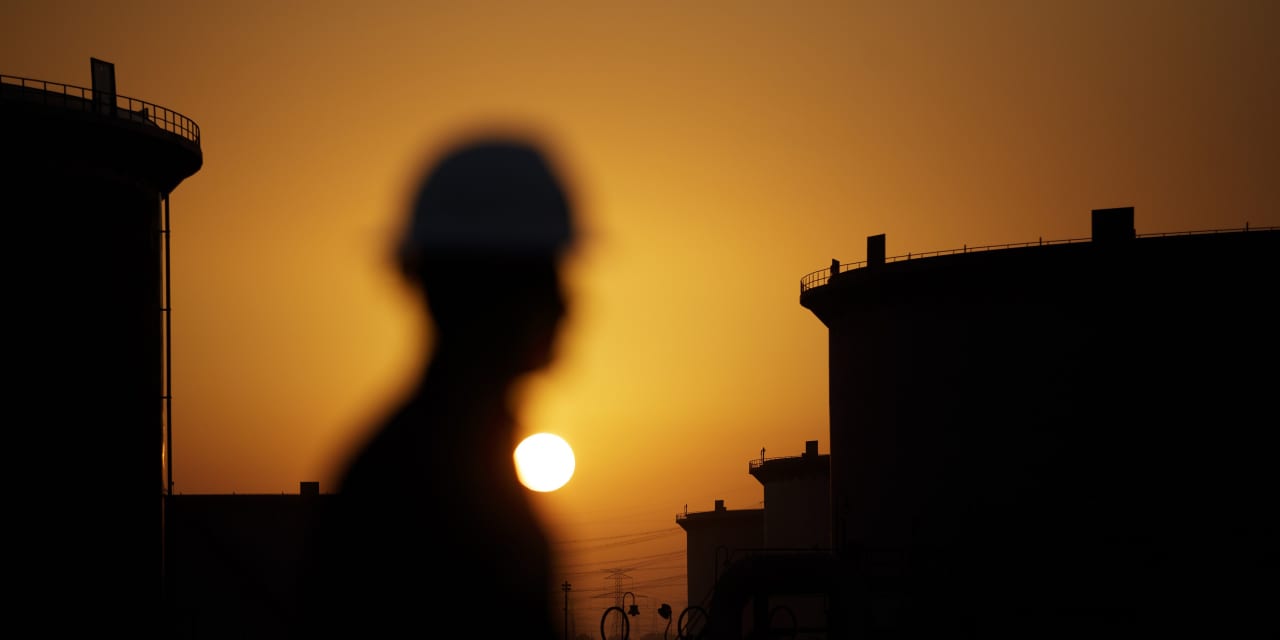
The sun sets over crude oil storage tanks in Ras Tanura, Saudi Arabia.
Simon Dawson/Bloomberg
About the author: Ben Cahill is a senior fellow with the Energy Security and Climate Change Program at the Center for Strategic and International Studies in Washington, D.C.
It is déjà vu for major oil producers, who are again considering steeper production cuts. It took only a month after the Hamas attacks on Israel unleashed a punishing war for oil prices to fall below their pre-Oct. 7 level. The steep drop in oil prices last week, with Brent crude briefly dropping to $77 per barrel, led to speculation that the Organization of the Petroleum Exporting Countries and allied producers (OPEC+) will decide to cut production at its next meeting. OPEC’s last-minute decision to delay the meeting, now scheduled for Nov. 30, will only add to the speculation.
Deeper production cuts are a strong possibility, but there are diminishing returns to production restraint. OPEC+ may find it easier to extend the existing cuts, but even this will require some political finesse.
The scenes of death and destruction in Gaza have produced a furious public reaction in the Middle East, including among oil-producing states. The oil market, however, seems strangely calm. Hezbollah has shown little willingness to ramp up attacks and incite a war on Israel’s northern border. Iran is exercising restraint rather than encouraging its clients in the region to create havoc, perhaps because regional diplomacy is preventing tit-for-tat escalation. Meanwhile, downside economic risks and high interest rates are dominating market sentiment, or at least trading positions. The market may be underestimating the threat of escalation. But for now, a “geopolitical risk premium” in the oil market—always a nebulous concept—is hard to discern.
All year, Saudi Energy Minister Abdulaziz bin Salman has been on a mission to counter bearish sentiment and regain control of the market narrative. After a bout of financial market weakness in the spring and a sharp drop in oil prices, in April some OPEC+ members announced voluntary cuts of 1.66 million barrels a day. Those reductions failed to have a lasting impact on prices. So the Saudi energy minister announced his memorably named “lollipop”—a one million barrels a day unilateral cut starting in July, now extended through the end of 2023—alongside a new Russian commitment to cut exports by 300,000 barrels a day from August through the end of 2023, on top of its 500,000 barrels a day production cut through the end of 2024. These deep cuts helped OPEC+ shift fundamentals and market sentiment. But Saudi Arabia probably anticipated a more lasting impact.
Where have things gone wrong for OPEC+? Oil demand has been quite strong this year, but robust non-OPEC supply has offset most of the OPEC+ cuts. U.S. crude oil production reached an all-time high in October of 13.2 million barrels a day, according to the Energy Information Administration, despite the industry’s ongoing spending restraint. Brazil, Guyana, and other countries increased production. And from May to September, Iran—exempt from OPEC+ quota restrictions—ramped up oil exports to levels not seen since 2019, as independent refiners in China bought discounted volumes and U.S. sanctions enforcement slipped. Add it all up, and steep fourth-quarter supply deficits have not materialized. Instead, the oil market looks relatively balanced.
OPEC+ ministers now face a choice between an extension of existing cuts or a steeper reduction. Directionally, Saudi Arabia might prefer the latter, but it faces a few challenges. First, after its 1.5 million barrels per day in voluntary cuts, Saudi Arabia is currently producing about nine million barrels a day—its lowest output in several years. Riyadh may be wary of another cut that would take the country to 8.5 million barrels a day or below, while potentially failing to produce a countervailing increase in revenue per barrel. And second, not all OPEC+ states are in a cooperative mood. The United Arab Emirates has been pushing for a higher quota for several years. In June it managed to secure a larger production allocation for 2024. Deeper cuts—albeit from a higher quota—would take it in the wrong direction.
Meanwhile, African producers in OPEC+ that have consistently failed to meet their targets will likely have their production quotas slashed and reallocated to other producers next year. A strong backlash to quota reductions makes it unlikely that Angola, Nigeria, and the Republic of Congo will play ball. Finally, Russia is a wild card. Its compliance with its production targets improved over the summer, but in recent weeks its seaborne oil exports have increased again. Moscow needs both higher volumes and elevated prices, and it is traditionally wary of cutting production and handing market share to U.S. shale producers.
So what will OPEC+ decide on Thursday? The most likely outcome is a rollover of existing cuts, perhaps for the first half of 2024, including the voluntary reductions from Saudi Arabia and Russia. This decision could be paired with stronger efforts to improve compliance from countries like Iraq and Russia, as well as complicated rearrangement of production targets for various countries. But it is quite possible that Saudi Arabia will again determine it has to shake up the market with a deeper OPEC+ production cut, perhaps of up to one million barrels a day. Riyadh would have to bear most of the burden as usual, along with cooperation from the Arab Gulf states. If OPEC+ follows this path, it will raise questions about how much longer Saudi Arabia is willing to act unilaterally and swallow lower production levels.
Guest commentaries like this one are written by authors outside the Barron’s and MarketWatch newsroom. They reflect the perspective and opinions of the authors. Submit commentary proposals and other feedback to [email protected].
Read the full article here