



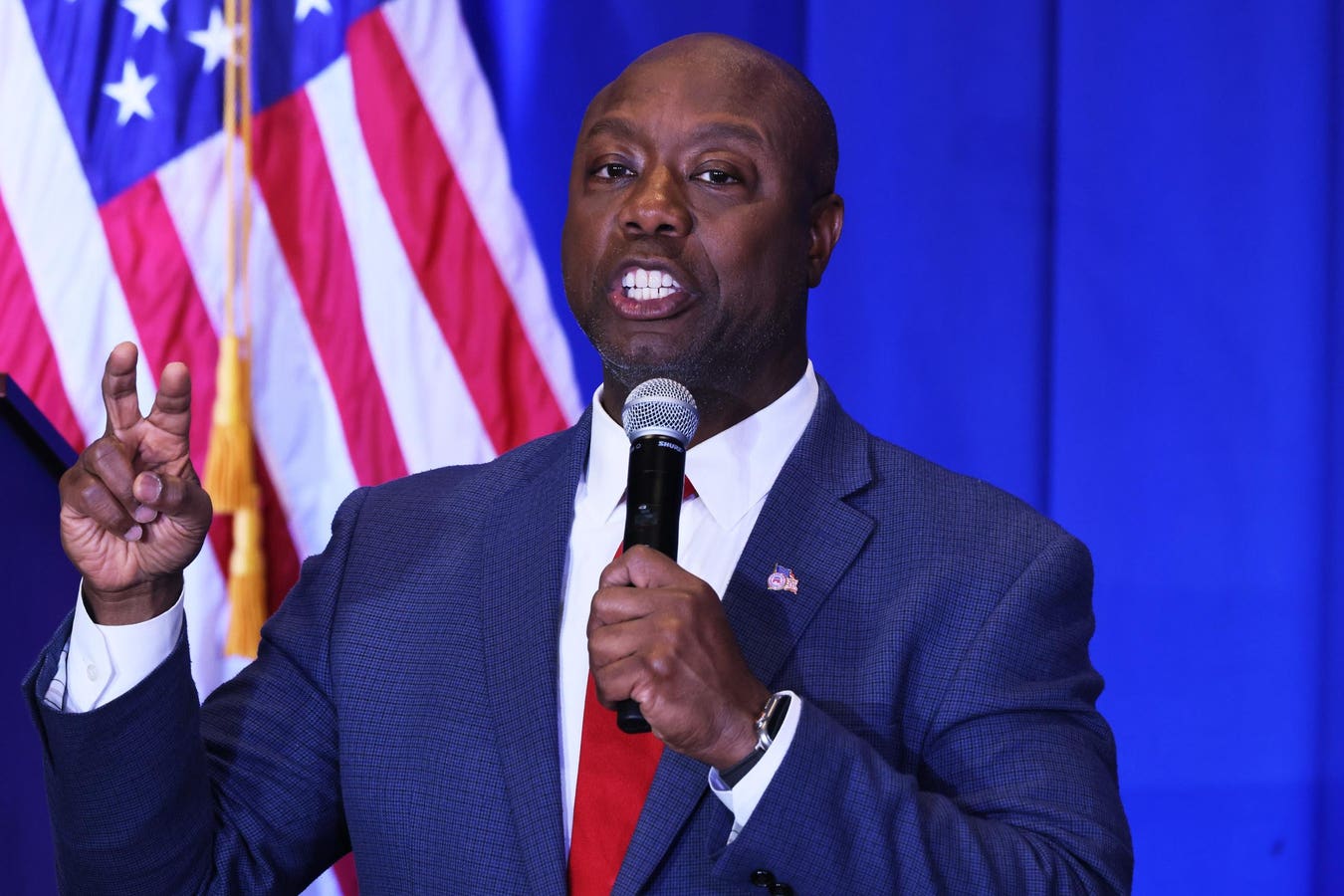
Sen. Tim Scott’s (R-SC) decision to drop his bid for the Republican presidential nomination means voters have lost their best opportunity to hear a serious tax policy debate among his party’s White House hopefuls.
Unlike his rivals, Scott campaigned on a thoughtful, relatively detailed agenda that married taxes with his conservative social and economic views. You might not have agreed with all of it. But at least you knew where Scott stood, something that can’t be said about his opponents.
I wish I could show you his plan, but Scott took down the content of his website when he suspended his campaign. But to get the gist, here is an analysis by the Committee for a Responsible Fdederal Budget (CRFB), an interview Scott did with CNBC and a nice summary of his plan by Kyle Pomerleau of the American Enterprise Institute.
Scott’s Agenda
Scott promised to:
· Make permanent all the individual income tax provisions in the Tax Cuts and Jobs Act (TCJA), which are due to expire at the end of 2025.
· Repeal the estate and gift tax.
· Permanently allow businesses to immediately write off the costs of equipment and research, and more rapidly depreciate buildings.
· Allow parents to claim the child tax credit (CTC) for unborn babies and make the adoption tax credit refundable.
· Expand his signature Opportunity Zones, which provided extra capital gains tax breaks to investments in designated communities.
Make no mistake, while Scott was quite specific about taxes, his overall fiscal agenda left plenty of holes to fill.
For example, he insisted his plan would reduce the federal deficit. But it didn’t add up. CRFB estimated it would add more than $3 trillion to the national debt over a decade, even with his proposed (and unrealistic) across-the-board cuts in non-defense, non-Social Security, non-Medicare spending. He never would say what he’d do about the looming insolvencies of Social Security and Medicare Part A .
Scott claimed he’d fill the fiscal gap because cutting taxes would increase revenue and reduce the deficit. But that idea is unsupported by evidence and has been rejected by nearly all economists.
Specifics Vs. Platitudes
Despite those shortcomings, his tax plan was specific enough that independent analysts (and voters) could make informed judgments about its virtues and flaws. Nearly every bullet point was accompanied by a reference to an actual bill in Congress. And while Scott left out some key details (on international tax, for example), you knew where he stood on revenue issues.
You can’t say that about his former GOP opponents. While Ron DeSantis had an aggressive tax cutting agenda as governor of Florida, he has been almost silent on what he’d do on fiscal policy as president. Former South Carolina Governor Nikki Haley has been somewhat more forthcoming, but her agenda still includes huge gaps. For instance, she promises to cut tax rates for working families but never says for whom or by how much. And she is silent on extending the TCJA.
Businessman Vivek Ramaswamy has a plan but it is internally inconsistent, veering wildly between vowing to never raise taxes, promising to boost the estate tax, and then denying he ever made such a pledge.
Former New Jersey governor Chris Christie has said little about his tax or budget policies, other than to promise to work with Democrats to reduce the deficit.
The Trump Factor
And Donald Trump? These days, his stump speeches focus on how he’d punish political opponents in a second term. Even his campaign website is more of a retrospective look at his first term than a policy agenda for a second. He never even quite says he’d extend the 2017 TCJA, perhaps his biggest legislative achievement.
The only real specific revenue proposal Trump has made is to impose a 10 percent tariff on nearly all imported goods. But he’s said nothing about how such a levy would work or what he’d do to mitigate the inevitable price increases it would cause for American consumers.
As long as Trump continues to dominate the GOP primary race, the details of fiscal policy will get little attention. He won’t talk about it. And his remaining challengers will continue to focus on attacking one another in a desperate attempt to be the last viable alternative standing when primary voters start heading to the polls or caucuses in late January.
But voters deserve a debate on tax policy, especially since the 2025 expiration of the individual provisions of the TCJA will force major decisions on the future of the revenue code soon after the next president is sworn in. The demise of Scott’s campaign leaves voters with a huge information gap, at least until the general election.
Read the full article here