



News doesn’t make the markets, the markets make the news. This maxim of traders is humbling, but yet instructive, to any financial journalist.
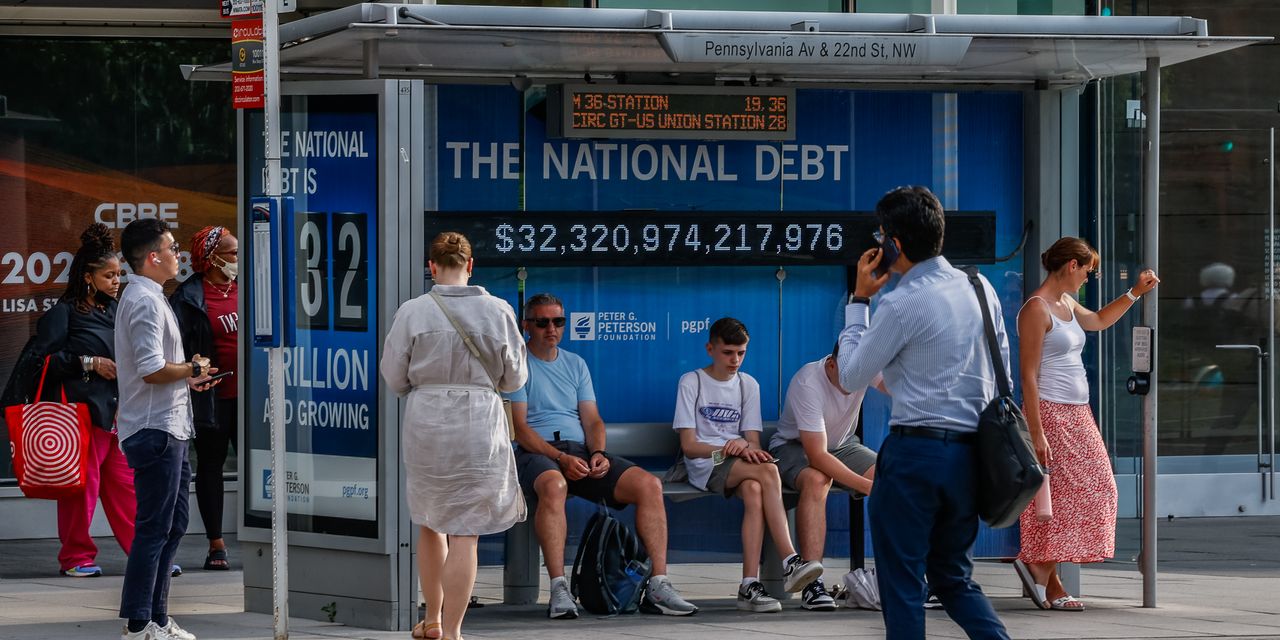
Yields on U.S. Treasury bonds have leapt in recent days, which the popular media ascribes to the downgrade of Uncle Sam’s credit by Fitch Ratings to AA+ from the previously pristine AAA. This confuses cause and effect, however. Treasury yields have been rising because the U.S. government has been borrowing huge amounts of money—some $1 trillion in this quarter alone.
That is at the core of Fitch’s decision, which, as is usual for credit-rating firms, follows what the market already is saying rather than leading it.
Further, Fitch’s action to strip the U.S. of its AAA rating follows a similar move by Standard & Poor’s in 2011. So the shock of this latest downgrade lacks some of the shock of S&P’s then-unthinkable move.
After all, you can only lose your virginity once. And, as former junk-bond king Michael Milken famously noted, a triple-A is only a downgrade candidate. Anyhow, BCA analysts archly observe that AA+ is the new AAA.
What matters is numbers, not letters. The ratings ultimately reflect a subjective analysis of a borrower’s likelihood to repay, based on its ability as well as its willingness to make good on its debt obligations. The latter figured heavily in both Fitch’s and S&P’s assessments; both criticized the toxic politics that would sacrifice the full faith and credit of the U.S., which Alexander Hamilton famously secured for the young republic.
And it is the numbers that have induced traders and investors to push up yields on longer-dated U.S. government securities to their highest level since last October—and concomitantly pushed down their prices. They see current 10- and 30-year Treasury yields, which have recently climbed above 4%, as too low.
Such levels only seem high in the context of the lowest yields in the 5,000 years of recorded history of interest rates—zero percent and negative in some markets—which were reached in the wake of the Covid-19 crisis. But the market is beginning to anticipate a continued rise in bond yields, which are based on U.S. government borrowing costs, which sets the standard for interest rates.
Not surprisingly, Treasury Secretary Janet Yellen took issue with Fitch’s negative assessment, which she said was based on outdated numbers. The strength of the U.S. economy was dismissed by the ratings arbiter, she asserted. Yet that missed the key point. Washington continues to go deeper into debt despite the economy running at full employment.
Rather than blaming the messengers at Fitch, administration officials should heed the message, which originates in the latter’s own numbers. In particular, the U.S. government’s fiscal-2023 deficit is already at 6% of gross domestic product at a time when Uncle Sam should be flush. Deficits of such magnitude are more typical of recession times, when tax receipts shrink and spending rises for unemployment and the like.
And the outlook for the future doesn’t look any better for the out years. For the proximate time, the Treasury recently announced expanded auctions of every maturity, including this coming week’s sales of $103 billion of three-, 10-, and 30-year maturities. At the same time, the Treasury also announced increases of every security, from short-term bills to longer-dated notes and bonds, as well as floating-rate notes and inflation-protected securities, which is at the core of the current backup in yields.
This comes as the Federal Reserve is selling off its holdings of Treasuries and agency mortgage-backed securities. Foreign central banks also are reducing their cache of U.S. debt. All of which means more paper for the private market to absorb.
The simple answer would be to reduce the budget deficit, through cutting spending or increasing revenues. Both are politically unpalatable. But there’s also a stealth solution that’s been successfully implemented before, most notably in the decades following the debt buildup that financed the World War II effort.
It consists of a combination of inflation and financial repression. The latter involves various institutional arrangements that suppress borrowing costs for the government. Inflation boosts the aggregate economy, with higher prices and wages measured in less-valuable dollars, and generates more tax revenue.
This combination was successful in paring debt during the 1945-80 period, wrote Carmen Reinhart and M. Belen Sbrancia in an International Monetary Fund working paper in 2015. These tools, which they described as a tax on bondholders and savers, might be deployed again to cope with the surge in public debt.
To be sure, the Fed’s stated intent is to return inflation back to its 2% target. According to its favorite measure—the core personal consumption expenditure, which excludes food and energy costs—it’s still running at twice that pace, at 4.1% in the 12 months through June. But why is 2% the right number?
That question has been posed by a number of economists, notably Olivier Blanchard, the former chief economist at the IMF and senior fellow at the Peterson Institute, who suggests a higher inflation target of, say, 3%. Wringing out the last bit of inflation could come at the cost of higher unemployment and wouldn’t be worth it, according to adherents of this view. And that extra inflation would swell government revenues.
Hedge fund titan Bill Ackman tweeted (or whatever the appropriate verb for Elon Musk’s redubbed X should be) this past week that he’s shorting long-term Treasury bonds, in part based on the assumption of inflation running at 3% over the long term, which he figures would imply a 5.5% 30-year Treasury yield. While the long bond’s yield has risen sharply of late, to 4.27% on Thursday from 3.84% in mid-July and 3.44% in early December, that 5.5% target implies significant further rises in yield and concurrent price declines. Shorting bonds (which he said he’s doing via options) further provides a hedge against his stocks, which would be vulnerable to declines owing to higher long-term interest rates, he added.
Ultimately, governments across the Group of Seven are likely to enact financial repression through policies similar to Japan’s yield curve control (which it just loosened), according to a new note from Bank of America’s global investment strategy team led by Michael Hartnett. They see that happening “once [the] next recession provokes fiscal policy panic & even higher government default risk.” Such financial repression would be the solution to the Treasury’s debt burden, which they observe will grow by $5.2 billion every day for the next 10 years, according to Congressional Budget Office projections.
The problem with long-term U.S. bonds isn’t so much their quality, as the Fitch downgrade suggests, as the quantity needed to fund Washington’s widening budget gap, especially as the normalization of interest rates further adds to its cost. Market players are making that point, and thus the news.
Corrections & Amplifications: The U.S. government’s fiscal-2023 deficit is 6% of gross domestic product. An earlier version of this article incorrectly said government debt is 6% of GDP.
Write to Randall W. Forsyth at [email protected]
Read the full article here