


We economists think labor bargaining power tells most of the story. Alan Greenspan was obsessed with labor power. His enduring question at the Federal Reserve was whether the economy could lower interest rates, risk a little inflation, and still not see workers winning the kind of wage gains that would push prices even higher.
Capitalists care deeply about worker power, too. If workers have it, they know they’ll have to share more of their profits. So right now, all eyes are on labor power — the ability of workers to negotiate better wages, better benefits, and better working conditions.
I practice good “data hygiene” by keeping close tabs on several key indicators of worker power:
- the “take-this-job-and-shove-it number” — the share of workers who feel confident enough to quit their jobs without another lined up;
- nominal wage growth (and whether wages are keeping ahead of inflation);
- how many workers are stuck looking for jobs for a long time; and
- broad unemployment and underemployment rates.
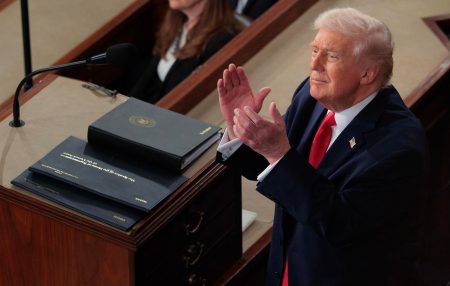
The Q1 2025 GDP number was strikingly sad: consistent with a coming recession. Friday’s jobs numbers are also downbeat. The Employment Situation report, released by the Bureau of Labor Statistics for April 2025, reveals that despite relatively strong nominal wage growth, real worker confidence and power are eroding during the first 100 days of President Donald Trump’s second term.
Take-This-Job-And-Shove-It: Falling Labor Power And Worker Confidence
The share of unemployed individuals who voluntarily quit their jobs is a direct measure of worker confidence — signaling whether workers believe they can find a better opportunity. In January 2025, 13.2% of the unemployed were job leavers; by April 2025, that number had fallen to 11.8%.
The steep drop shows that fewer workers are willing to take the risk of quitting without another job lined up — an unmistakable sign that confidence is falling fast.
I back up my interpretation of the job leaver data with numbers from the Job Openings and Labor Turnover Survey, which is released separately from the more famous first Friday “jobs report” each month. As discussed in my previous Forbes blog, I use both the Employment Situation and JOLTS data to better understand shifts in bargaining power.
The JOLTS quits rate — the percentage of workers voluntarily leaving their jobs each month — peaked in 2021 at 3.0%. As of February 2025, the quits rate has dropped to 2.2%. The continued drop in the quits rate confirms the sharp decline in worker confidence already showing up in the main jobs data.
Strong Nominal Wage Growth, So-So Labor Power
Wage growth is one primary sign of labor market strength. In April 2025, average weekly earnings for all employees on private non-farm payrolls rose by 0.3% to $1,080. The increase in earnings can reflect an increase in pay and an increase in hours. So, these numbers aren’t anemic.
Over the past 12 months, nominal earnings have increased by 3.8% seasonally adjusted. Wages are still up. Inflation has moderated: The Consumer Price Index for All Urban Consumers (also known as CPI-U) rose by 2.4% over the same 12 months.
Thus, real wages increased by about 1.4% year-over-year — a modest but positive gain in purchasing power.
Wages rose modestly across the major employment sectors between January and April 2025. In one of our big sectors — health care and social assistance — where about 20 million workers are employed, the average hourly wage (without adjusting for inflation) increased from $35.90 to $36.20, a gain of 30 cents. In retail trade, which employs around 15 million workers, average hourly wages rose from $22.17 to $22.50, an increase of 33 cents.
The professional and business services sector, with approximately 22 million workers, saw hourly wages move from $41.60 to $42.00, a rise of 40 cents. Meanwhile, in leisure and hospitality, a sector that includes 14 million workers, average hourly earnings grew from $20.05 to $20.30, a 25-cent gain. Overall, across the private sector, covering about 130 million workers, average hourly earnings climbed from $34.55 in January to $35.00 in April, an increase of 45 cents.
Underemployment And Unemployment Are Rising, Labor Power Is Down
Long term unemployment is rising. The so-called U-1 rate (people unemployed 15 weeks or longer) is our number to capture the sadness and frustration — not to mention lost output — of people pounding the pavement and the keyboard looking for work for a long time (the labor department stops counting after 52 weeks, but many people continue to look after a year). Expressed as a percent of the civilian labor force the numbers show how deeply entrenched unemployment is becoming. In January 2025, the U-1 rate stood at 1.5%. By April 2025, it had climbed to 1.9% — a 0.4 percentage point increase. An uptick like this suggests that it’s getting harder for unemployed workers to get back to work, eroding their bargaining position even further.
Underemployment also climbed. The broader underemployment measure (called U-6 by economists) captures the “officially unemployed” as well as the people that could work more but are discouraged from seeking work and others who don’t have enough hours and are working part-time for economic reasons. In January 2025, the U-6 rate was 7.5%. In April 2025, it rose to 7.8% — a 0.3 percentage point increase. And over the past year the U-6 rate is up by about 0.5 percentage points, showing a creeping rise in involuntary part-time work and broader underemployment.
That’s not good for labor power.
Slippage In Labor Power
In summary, although the stock market may be up today — generally bad news for workers is a good sign for capital — the signs for working Americans are not good.
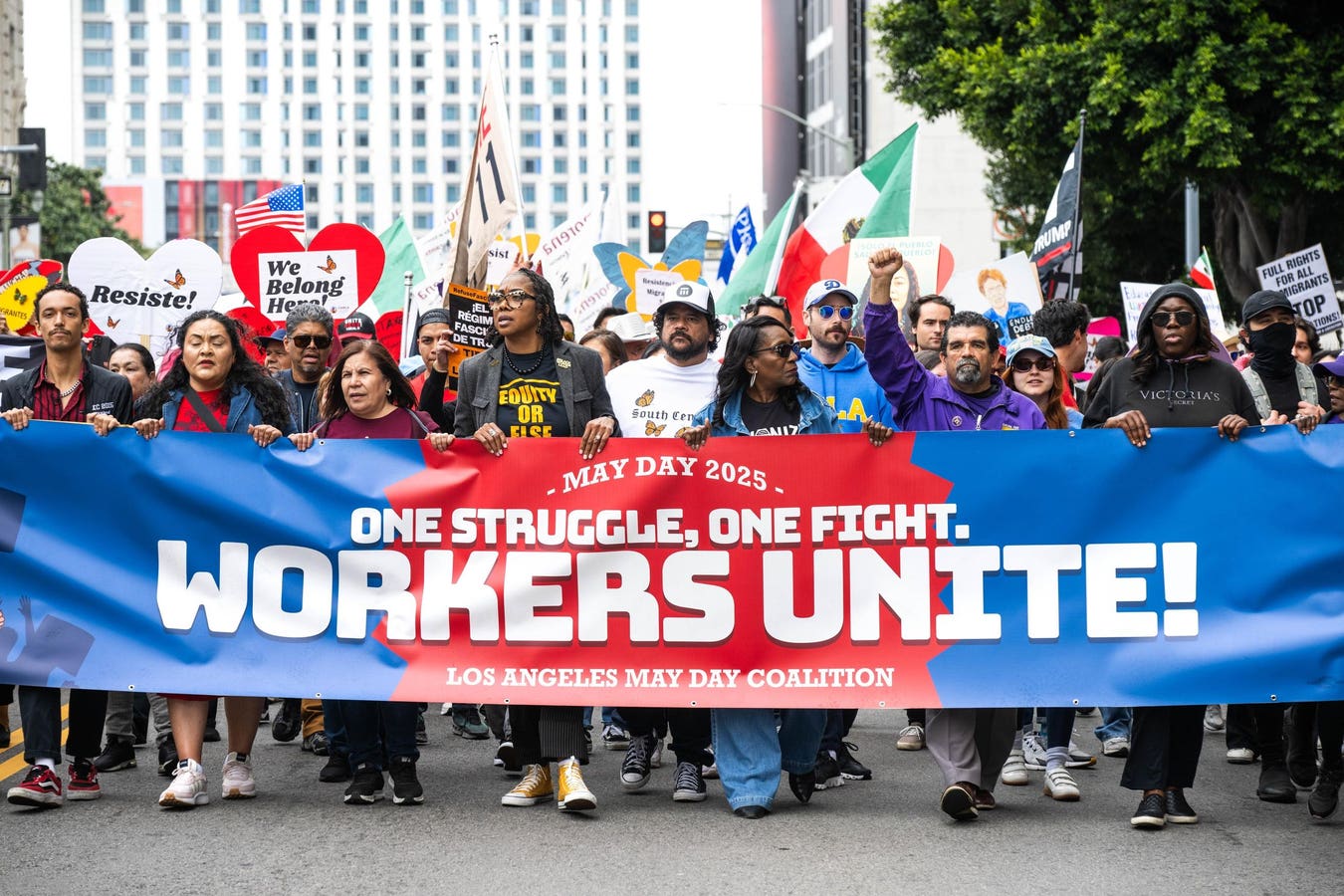
May Day rallies across the United States saw large crowds — over 100,000 people nationwide across dozens of cities called for stronger worker rights and better wages, Reuters reported.
These signals point to weakening labor bargaining power during the first 100 days of Trump’s presidency.
- There’s a steep fall in worker confidence.
- Real wage gains are modest.
- Long-term unemployment is climbing.
- Broader measures of underemployment (U-6) have worsened.
And the jobs numbers punctuate the verve of the May Day rallies. The people there are many, and the people running the Trump presidency are few. So, if all signs point to weakening labor bargaining power during the first 100 days of Trump’s presidency how will the economy — and the ballot box —judge its effects? I don’t want a recession. I’m keeping close watch for signs.
For the sake of the standard of living of American households, I hope this weakening trend doesn’t harden into a lasting pattern of lost worker gains.
In his testimony before the Senate Banking Committee on February 26, 1997, Greenspan said: “Atypical restraint on compensation increases has been evident for a few years now, and appears to be mainly the consequence of greater worker insecurity.”
Read the full article here