



LONDON — U.S. moves to de-risk from China with a new investment ban suggest that Western allies may be learning from national security failings in Russia, according to analysts.
The White House on Wednesday announced a ban on some U.S. investment in China in sensitive technologies such as computer chips, in the latest ratcheting up of Washington’s disassociation from Beijing amid perceived national security risks.
Analysts said the U.S. was making such moves with an eye on rising tensions in Taiwan, given that the potential fallout from a conflict between China and Taiwan would be “unimaginable.”
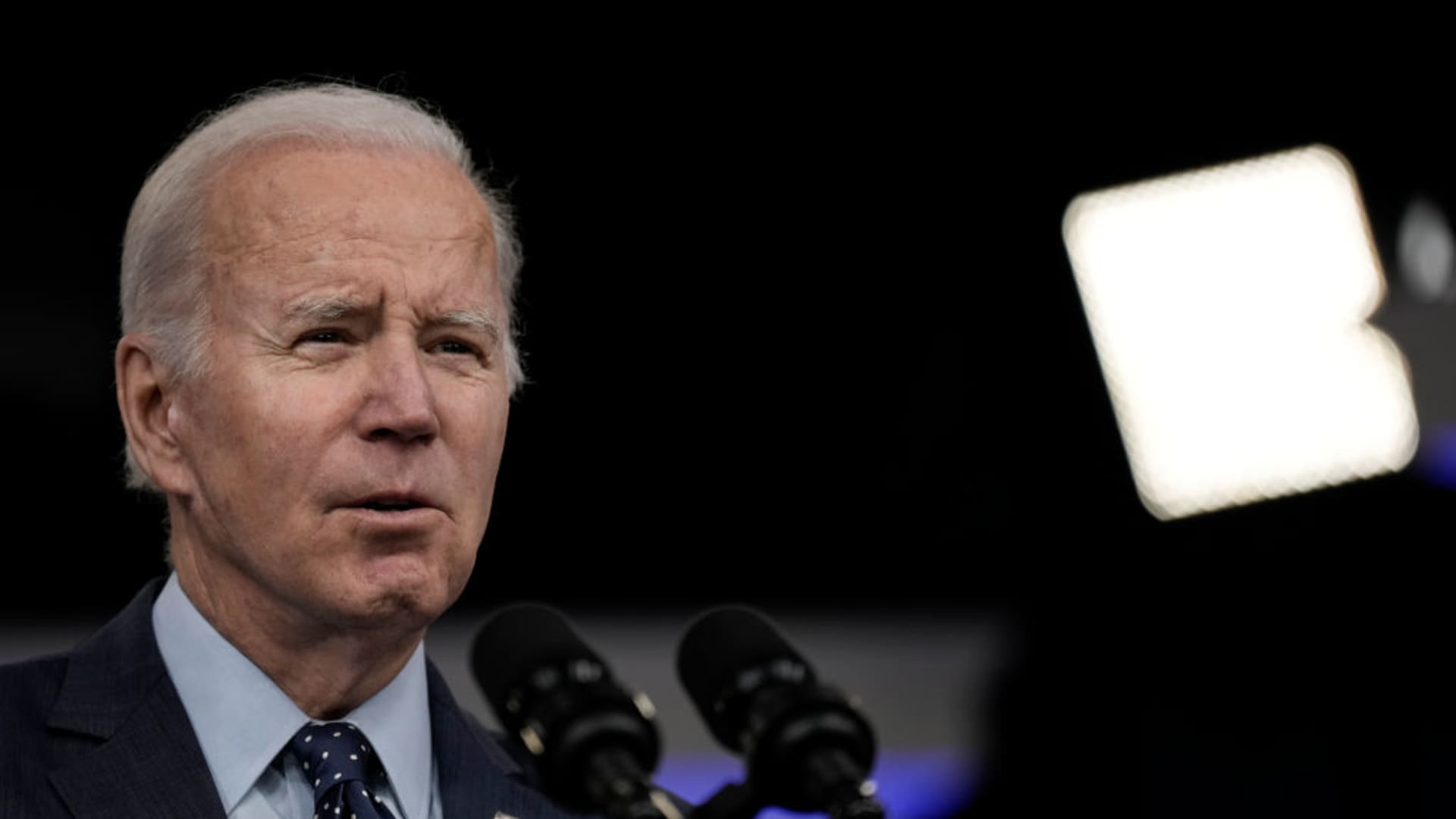
U.S. President Joe Biden said the executive order, which will come into effect next year, aims to ensure that China’s military does not benefit from American technology and funding, particularly in sectors that “counter United States and allied capabilities.”
Such moves have sometimes been referred to as a “decoupling” of the world’s two largest economies, though the U.S. has preferred the term “de-risking.”
Beijing hit back at the announcement Thursday, with the foreign ministry saying it was “resolutely opposed” to what it dubbed the U.S.’s “blatant economic coercion and technological bullying.” China’s ambassador to Washington has previously warned that Beijing would retaliate against such measures.
These preemptive ideas about decoupling … that’s all done with a view to potential conflicts.
Olena Yurchenko
advisor at the Economic Security Council of Ukraine
“These preemptive ideas about decoupling — taking the manufacturing and the manufacturing facilities from China to India et cetera — that’s all done with a view to potential conflicts, so that when it erupts, let’s say in Taiwan, it’s not so excruciating to impose some restrictions,” said Olena Yurchenko, advisor at the Economic Security Council of Ukraine. Yurchenko, who spoke to CNBC ahead of the Wednesday announcement, dubbed the scale of the risks regarding Taiwan as “unimaginable.”
Taiwan has been governed independently of China since the end of a civil war in 1949, but Beijing views the island as part of its territory.
The dispute over Taiwan is a global flashpoint, with most in the West considering it a self-governing nation. Beijing, meanwhile, has called for “reunification” with Taiwan, last year describing its status in a white paper as an “unalterable” part of China.
Prominent China hawk Kyle Bass, who said he had consulted military experts, told CNBC Tuesday that he believes Chinese President Xi Jinping could launch an attack on Taiwan as early as next year. He cited Beijing’s recent ratcheting up its military drills around the Taiwan Strait. CNBC could not independently verify his assertions.
The Chinese government did not immediately respond to CNBC’s request for comment on Bass’ assertions. However, it has previously said the issue with Taiwan is an internal affair and its military exercises are in response to repeated meetings between Taiwan’s president and U.S. representatives — a red line for Beijing.
Learning lessons from Russia
The U.S. has been forthright in its aims to de-risk from China, with the Biden administration ramping up measures over the past several months amid growing global tensions following Russia’s full-scale invasion of Ukraine.
The Economic Security Council of Ukraine’s Yurchenko, whose work closely follows geopolitics and international relations, said the timing of the two events was no coincidence.
“This is kind of a long-term lesson the Western governments try to learn from what they’ve seen in Russia,” she said.
Western allies have slapped unprecedented sanctions on Russia in response to its ongoing war. Still, CNBC analysis shows that Moscow is able to circumvent sanctions by relying on intermediary countries to help it import Western goods, including advanced technologies for its military equipment.
Elina Ribakova, senior fellow at the Peterson Institute for International Economics, said that China was watching the West’s approach to Russia closely. China has been cited as the primary intermediary supplying Western tech to Russia’s military.
“If we’re not effective with Russia, if China is the one playing the key role in helping Russia circumvent these export controls, then how can we possibly think that we’ll be effective against China if something were to happen with Taiwan?” Ribakova said.
The Chinese government did not respond to a request for comment on Ribakova and Yurchenko’s statements.
Western sanctions against Moscow keep coming, almost one-and-a-half years after Russian forces crossed Ukraine’s borders.
The U.K. on Tuesday announced new sanctions on a range of foreign businesses accused of supplying Russian forces with weapons and components for use against Ukraine.
This follows the European Union’s introduction in June of a new package of sanctions, which includes an anti-circumvention tool to restrict the “sale, supply, transfer or export” of specified sanctioned goods and technology to certain third countries acting as intermediaries for Russia.
Asked last month whether the sanctions might send a message of potential repercussions from any possible future conflicts, including between China and Taiwan, European Commission spokesperson Daniel Ferrie told CNBC he could not comment or speculate on the future.
Reducing ties with China
As the world’s second-largest economy, China’s contributions to — and its role within — international relations and global markets are widely recognized as far exceeding those of Russia, prompting heightened caution from the West.
The European Union has thus far been more ambivalent than the U.S. in its approach to China. The British government, for its part, said Wednesday that it was considering whether to follow the U.S. as it continues to assess “potential national security risks attached to some investments.”
We need to be more firm. I’m not saying immediately decouple and walk away, although I think that’s what will happen.
Kyle Bass
founder and chief investment officer at Hayman Capital Management
However, Bass said that Western allies’ current approach of a “slow decoupling” could be misguided, leaving governments to “improvise” quickly if a conflict involving Taiwan broke out.
“We need to be more firm. I’m not saying immediately decouple and walk away, although I think that’s what will happen,” he added.
Speaking to CNBC’s “Street Signs” Tuesday, before Biden signed the executive order, Bass, who is founder and chief investment officer at Hayman Capital Management, supported the prospect of new guidelines around U.S. investment in Chinese tech.
“We should have very strict outbound restrictions on surveillance companies, on genomics companies, on any companies that deal with Chinese military building their aircraft carriers, their war machines, their ships, their tanks,” he said.
Read the full article here


