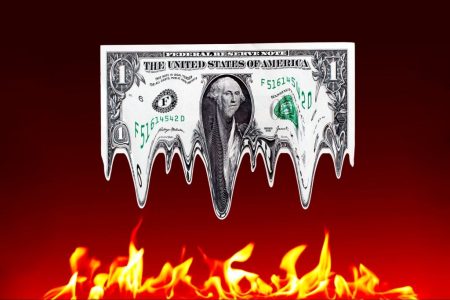




This one of those times when a combination of serious, negative pressures will test the U.S. financial system. The test is potentially disastrous because the past actions of the Federal Reserve and the U.S. Government will be of no help. That’s because their actions created the pressures (think inflation and over-leverage).
For example, The Wall Street Journal today (Aug. 7) highlighted one pressure in, “A Real-Estate Haven Turns Perilous With Roughly $1 Trillion Coming Due.” (Underlining is mine)
“Apartment buildings, long considered a real-estate haven, are emerging as the next major trouble spot in the beleaguered commercial-property world.
“Investors bid up the prices of multifamily buildings for years, attracted by steadily rising rents and the prospect of outsize returns. Many took on too much debt, expecting they could raise rents fast enough to pay it down.
“Unlike office buildings and malls, which have been hit hard by remote work and e-commerce, rental apartments have low vacancy rates. The apartment sector’s main problem isn’t a lack of demand—rents have soared since 2020—it is interest rates.
“The sudden surge in debt costs last year now threatens to wipe out many multifamily owners across the country. Apartment-building values fell 14% for the year ended in June after rising 25% the previous year, according to data company CoStar. That drop is roughly the same as the fall in office values.”
Very important: That decade-long, Fed-created, near-0% interest rate environment, hyped by “QE” (quantitative easing = increased money supply), was irresistible to many (most?) major borrowers. Did it help consumers? Not much. But it certainly was a prime gift to hedge funds, private funds and other investors. Their assets grew to surpass the entire banking system while making the owners wealthy.
Worse, that low-rate benefit wasn’t paid for by the Fed. Instead, the Fed forced all savers, investors and financial firms, institutional funds and organizations with reserves to earn next to nothing. This, even as the Fed touted it was keeping inflation at “only” around 2%. After the first ten years, those $trillions of short-term deposits and investments lost over 20% in purchasing power. This egregious action was never discussed by the Fed nor addressed by Congress (another beneficiary of near-0% borrowing rates). Besides Barron’s cover article that berated the Fed in late 2009, little was written about the Fed’s inequitable treatment of capital providers (savers and individual investors) and capital users.
Yesterday’s “cure” in now impotent
Naturally, reading that higher interest rates are the problem for over-leveraged firms, funds and investors, the solution would seem to be Federal Reserve rate cuts. However, such an action is unacceptable for these five reasons:
- First, the low interest rates initiated the problem. They encouraged massive borrowings (leverage) throughout the financial system. Those borrowings allowed both expansion and increased net income. The borrowers’ mistake -obviously- was expecting low rates to remain.
- Second, the drop in asset prices won’t be reversed by lower interest rates. Few potential buyers will pursue the previous borrow-and-buy actions that would inevitably be undermined when rates rise again.
- Third, the interest rates only match the fiat money inflation rate of about 5% (i.e., the rate by which the U.S. dollar is losing purchasing power each year). The Fed’s so-called tightening has not even begun. That action requires rates well above the inflation rate.
- Fourth, the Fed has barely reversed the $trillions of new money supply it created. That excess money continues to circulate and bolster inflation today. Therefore, increasing the money supply further would provoke more inflation angst.
- Fifth, inflation mentality is in full force in the corporate world. Moreover, consumers and labor (e.g., unions) are now taking actions to better match income and higher living expenses. Therefore, an announcement that the Fed was weakening the inflation fight by lowering interest rates would be ill-received.
The bottom line – Acting sooner is always preferable
With so much low-cost debt-leverage maturing over the next year or two, a form of financial chaos is likely. With higher interest expense, net income will be a major concern. Will asset prices fall? Probably, because buyers will be cautious and some troubled properties (collateral) will fall below the debt owed.
With the large breadth and depth of leverage, there is no way to know how or when the mess gets straightened out. However, there is one thing we can count on – surprise announcements. Creditors and debtors, alike, will be silent about negative developments. Going public before a solution is worked out would mean putting both parties and the assets in a negative light. That’s why waiting until we know what’s going to happen is a risky proposition.
As an example, think of the regional banks. The few extreme screwups were taken care of. However, for the hundreds of others without a currently pressing need, business goes on as usual. Except, the three causes remain:
- Large depositors with accounts well above the “old” FDIC insured deposit limit. (Are all these excess deposits now guaranteed for all time?)
- Supposed excess assets invested in lower interest rate, long-term bonds whose market value is now well below cost. (Will those assets not be needed for many years?)
- Net interest margin (NIM) declines as depositor interest expense rises (driven by competition) and bond interest income remains level. (How low will it go?)
So, now looks like the time to hold safe, short-term securities. The 5+% yield is good, and the ready reserves will be valuable when the right time comes. How long will that be? Good question. Past financial system shakeups have taken many months.
Read the full article here